
Why the mouth matters more than families expect
Ask your parents how they are and you will hear "fine." Ask about their knees, their sugar, their blood pressure, and you will usually get a real answer. Ask about their teeth and you will get nothing at all, right up until the day they stop eating properly.
The instinct is to file dental care under cosmetic, or at best under comfort. It sits much closer to the centre than that. The mouth is often where a systemic problem shows itself first: diabetes, hypertension, cardiac conditions, kidney and liver problems can all announce themselves through changes in the gums and soft tissue before they are picked up elsewhere.
Digestion is the other half of it. The digestive process begins in the mouth, so a parent who cannot chew comfortably is absorbing less from the same meal. Recurring gastric discomfort in an elderly parent occasionally traces back to teeth rather than to the stomach.
There is a direct loop with diabetes in particular. Diabetic patients accumulate plaque more readily and are more prone to gum inflammation, partly because so many of them have a dry mouth. Gum disease in turn makes blood sugar harder to control. For a diabetic parent, Dr. Nizar's position was unambiguous: a checkup and a professional cleaning every six months is not optional.
The one sign that needs a dentist within days
Most of what follows is "raise it at the next appointment." This one is not.
A mouth ulcer that has not healed after six weeks needs a dental consultation, to rule out oral cancer.
Ordinary ulcers come and go in a week or two. One that persists past six weeks is in different territory and should be screened rather than watched. If your parent mentions a sore spot that "has been there a while," find out how long "a while" actually is.
The related sign is a white or red patch inside the mouth that cannot be scraped off. It may turn out to be a fungal infection such as candidiasis, which is common and treatable, but the patch itself needs a professional look rather than a guess.
The signs worth watching for
Bleeding gums
Blood in the sink after brushing is the single most commonly ignored dental symptom, because it is painless and it stops. It should never be dismissed. Most often it signals gum disease. Occasionally it points to a Vitamin C deficiency instead. Either way it has a cause, and the cause does not resolve by itself.
Untreated gingivitis (inflamed, red, tender gums) progresses to periodontitis, where the bone supporting the tooth is destroyed and the tooth loses its attachment. That progression is slow, silent, and ends in teeth shedding.
Loose teeth, and the myth underneath them
Losing teeth is not a normal part of getting older. It is worth saying plainly, because a great many families in India treat it as inevitable and therefore not worth a dentist's time. Teeth are lost to disease, not to birthdays. A loose tooth in a 70-year-old is a finding, not a milestone.
Untreated decay is not a small matter either. It can progress to severe facial swelling and, rarely, to a life-threatening infection such as Ludwig's angina. Dental infections in older adults deserve the same urgency as any other infection.
Dry mouth
This one is almost universal among elderly parents, and almost always missed, because the cause is usually the medicine cabinet. Antihypertensives, antipsychotics and a range of other long-term medications reduce saliva flow. Since most older adults are on several medications at once, the effect compounds.
Saliva is what continuously cleanses the teeth and holds bacteria in check. Without enough of it, decay accelerates, the mouth burns, and dentures stop sitting securely. If your parent takes three or four daily medications, assume dry mouth is a live risk and ask about it.
Tooth wear
Enamel wears down with decades of use, and acid reflux speeds it up considerably. A parent with long-standing gastroesophageal reflux is wearing their teeth from the inside as well as the outside.
Changes in how they eat
This is the one that travels best across a phone line, and it is the reason it belongs on this list at all. Watch for a parent who:
- has lost interest in food they used to enjoy
- has started avoiding hard or crunchy items
- chews consistently on one side
- takes noticeably longer over a meal
- has persistent bad breath
Any of these can mean chewing hurts, or that a denture no longer fits. Older adults will adapt their diet around a painful tooth for months rather than mention it. Pus draining anywhere in the mouth needs to be seen immediately.
Dentures: the thing most families get wrong
If your parent wears dentures and you only change one habit after reading this, make it this one. Dentures come out at night. The gum tissue underneath needs hours without pressure to recover. Worn continuously, a denture leads to denture stomatitis, an inflammation of the tissue beneath the plate.
The full routine Dr. Nizar recommended:
- Clean the denture after every meal.
- Take it out at night, every night.
- Soak it in an antiseptic or antifungal solution.
- Leave the mouth free of the denture for a few hours each day so the tissue can recover.
Two other things are happening at the same time. Bone resorption and gum recession continue with age, which is why a denture that fitted perfectly three years ago now slips. And aggressive brushing with a hard brush accelerates that recession. A denture that has started to move is not one the wearer should be tolerating, it is one that needs refitting.
What to ask on your next call
Vague questions get "fine." Specific questions get answers. Try these:
- Do your gums bleed when you brush?
- Is your mouth feeling dry, especially at night?
- Is there any food you have stopped eating recently?
- Does your denture feel loose, or is it rubbing anywhere?
- Is there a sore spot in your mouth? How long has it been there?
- When did you last see a dentist?
The last one is often the most revealing. Ask it every few months rather than once a year.
Prevention, and what to do if they cannot travel
- A soft-bristled brush. Hard bristles cause the very gum recession you are trying to avoid.
- Fluoride toothpaste, twice a day, and daily flossing.
- A dental checkup every six months, and for diabetic parents a professional cleaning at the same interval. In Kerala, dental screening is increasingly folded into routine general medical checkups, so this is easier to arrange than it used to be.
- Green leafy vegetables in the diet. Vitamin D and Vitamin C deficiencies are common in older adults and may need supplementation if absorption is poor, which is worth raising with their physician.
This is the part most families abroad do not know: home dentistry is genuinely available in Kerala. Mobile dental setups run out of a number of clinics and dental colleges, which changes the picture entirely for a parent who lives alone, no longer drives, or finds the trip to a clinic exhausting. "They cannot travel" is a solvable problem, not a reason to let six-monthly checkups lapse.
Keep a record, and keep it where you can reach it
The practical failure mode for families abroad is not ignorance, it is that the information lives in one person's memory in another timezone. Write down and keep current:
- the dentist's name and phone number
- your parent's current medication list, which is what predicts dry mouth in the first place
- any follow-up instructions from the last visit, and the date it happened
When a sibling calls you at 2am because something has flared up, that list is the difference between acting and guessing.
The speaker

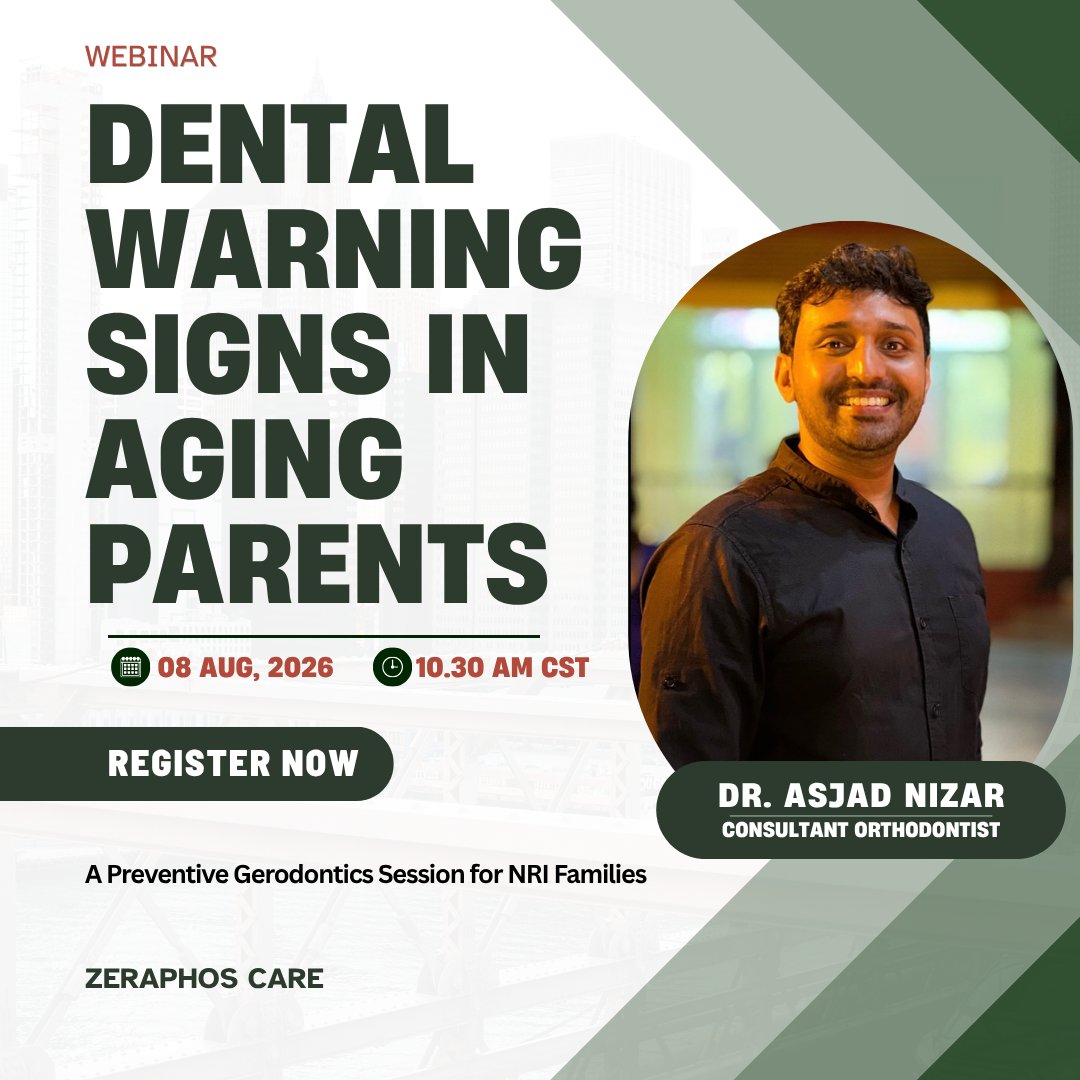
Dr. Asjad Nizar
BDS, MDS, FPFA · Consultant Orthodontist, Master Dental Care, Maldives
Dr. Nizar is a practising specialist orthodontist who trained in Kerala and Mangalore, with further training in advanced orthodontics at Yonsei University in Seoul. He is a Fellow of the Pierre Fauchard Academy in the USA and has published more than 12 papers in national and international dental journals.
In this session he focused on what families can notice early, and on the point at which a small dental problem starts affecting a parent's nutrition, sleep, and confidence.
LinkedInMore from our live sessions
Let's Talk About Falls
Written up from our October 2026 session
This webinar is for awareness and education only. It is not a substitute for a personal dental consultation, diagnosis, or treatment. Zeraphos is not a hospital, clinic, or emergency service. For anything urgent, contact a doctor or emergency services.